



© Vasco Stocker Vilhena

João Pedro Vale + Nuno Alexandre Ferreira, Cry, Boy, Cry (2026)
Performer: Cire Ndiaye

João Pedro Vale + Nuno Alexandre Ferreira, STUD (2026)
Performer: Diogo Bento

João Pedro Vale + Nuno Alexandre Ferreira, RISE (2026)
Performer: Afonso Peixoto

João Pedro Vale + Nuno Alexandre Ferreira, SLAM (2026)
Performer: Ângelo Castro
© Alípio Padilha
May 26 10pm — 12am Opening
Performance with Afonso Peixoto, Ângelo Castro, Cire Ndiaye, Diogo Bento
May 29 5.30pm — 7pm Guided visit with the artists + Performance
July 4 5pm - Repetition of the performances
The invitation convening guests to DAWN, the new exhibition by João Pedro Vale and Nuno Alexandre Ferreira, features an image appropriated from Vivienne Westwood’s iconic Two Cowboys T-shirt (1975), originally designed for the SEX shop on King’s Road in London. Here caricatures of the artists replace the two pantless cowboys, reactivating a provocative image that challenged heteronormativity and censorship at the time, and underscoring its ongoing urgency today.
DAWN presents a new body of work that continues the duo’s ongoing research into the social and political agency of queer nightlife. The title evokes a liminal moment: the passage between night and day, evoking memories of walking home at daybreak after a long night out, when traces of the night still linger on the breath and body. This threshold condition — between pleasure and precarity, anonymity and exposure, private and public — extends through the exhibition.
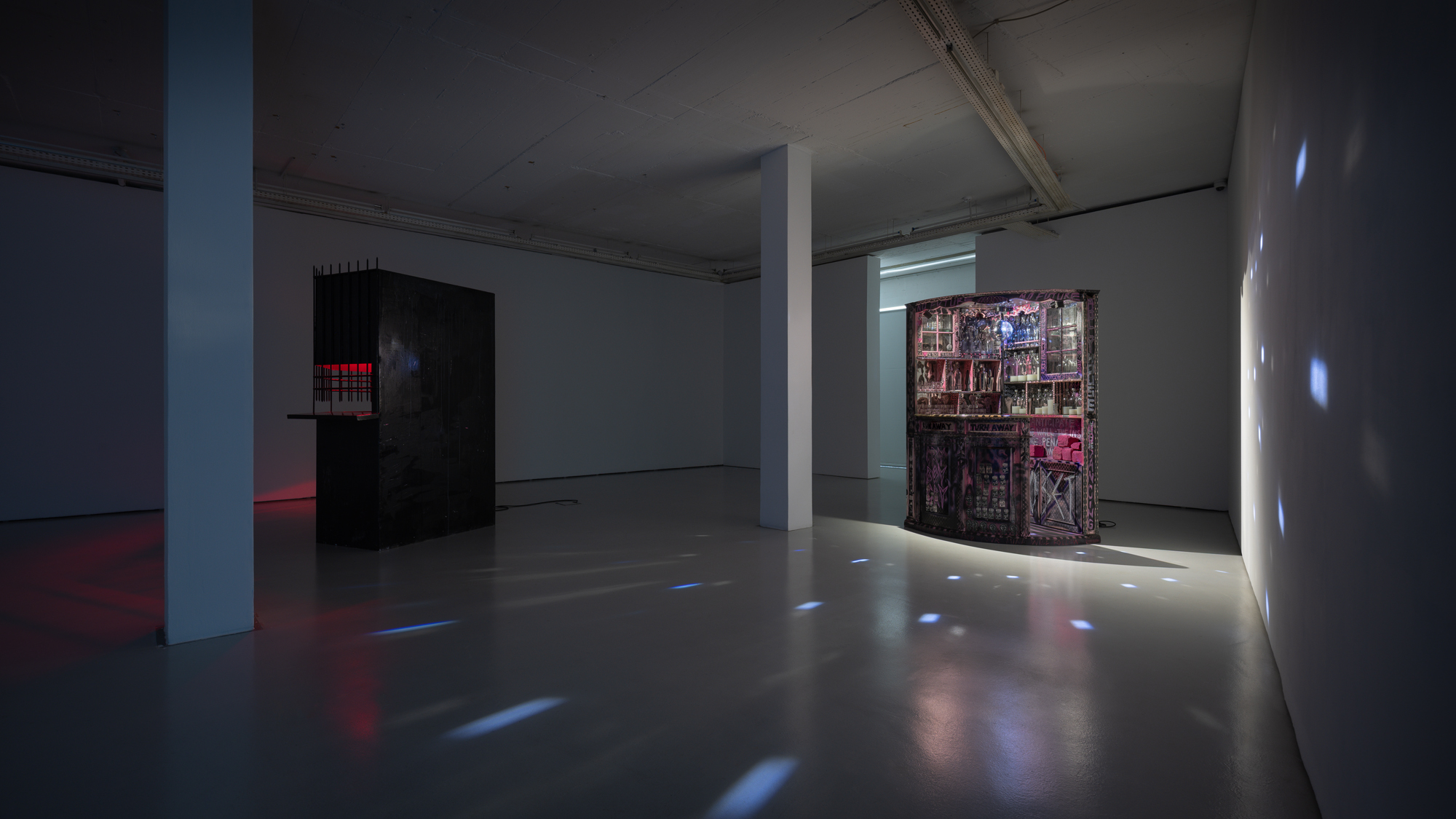
The gallery is transformed into a parcour of sculptural bars: hybrid objects operating simultaneously as architecture, narrative, and stage. These works do not merely represent bars; they perform them. The design of each structure proposes a distinct formal and symbolic vocabulary, while collectively examining the bar as a social space capable of producing proximity between strangers and creating community. Activated by performers-cum-bartenders at specific moments during the exhibition, the sculptures oscillate between inert installation and lived environment.
This dynamic extends into the body through a cocktail conceived especially for the exhibition. Also called DAWN, it is a mix of champagne, passion fruit juice, vanilla, and bagaço. Prefacing the show are individual portions packaged in medicinal-style bottles stacked in cardboard boxes at the gallery’s entrance. Like the bar itself, it facilitates encounters by altering perception and loosening boundaries. In this way, the exhibition can be experienced beyond the visible; it continues metabolically, becoming part of those who choose to drink the concoction.
Bars have always been more than social environments; they have also operated as political spaces, particularly for queer communities. They provide not only places to meet, but spaces to exist — to practice ways of being and forms of desire, otherwise unavailable in public life. Functioning both as refuge and stage, the bar sustains a productive tension between anonymity and exposure. Historically, bars like the Stonewall Inn in New York have proven to be safe havens where marginalized communities could gather, exchange, and organize. Vale and Ferreira draw on this lineage alongside personal experience, framing the bar as a site where pleasure and dissent remain inseparable.
Borrowing from the melancholic yet liberating tune of “Smalltown Boy” by the ‘80s band Bronski Beat — a song that has long functioned as anthem for the gay community, the first bar we encounter, Cry, Boy, Cry (2026), is adorned with a dense accumulation of visual and textual fragments informed by semiotics of queer nightlife. Graffitied surfaces bear phrases from pop music, activist discourse, and intimate confessions. The line “Run away, turn away...” greets guests and functions simultaneously as instruction and condition, articulating a continuous movement between spaces, identities, and states of belonging. In this way, the exhibition itself defies a linear narrative, but a constellation of overlapping and shifting moments.
While Cry, Boy, Cry foregrounds language and affect through a visceral, nightclub bathroom aesthetic, the subsequent bars are more subdued in design but no less extravagant and layered in meaning. STUD (2026), constructed from iron, glass goblets, wine packaging, and red lightbulbs, condenses the visual codes of desire and consumption into a minimalist but charged, almost ritualistic environment, with the saturation of red light evoking both intimacy and exposure. The work suggests a choreography of display and seduction, where objects become proxies for bodies and gestures.
In RISE (2026), acrylic and iron frameworks support glass bottles take form of Molotov cocktails, illuminated by a system of programmable LEDs. The shifting colors correspond to different drinks served by performers but continue to change even in their absence. The reference to the Molotov cocktail suggests an undercurrent of potential unrest in such politicized spaces, mixing pleasure with volatility.
SLAM (2026) offers a more scenographic and immersive register, incorporating a bathtub, tiled surfaces, mechanized elements, and bronze phallic faucets spewing water. The presence of water — circulating, contained, or potentially overflowing — evokes a sense of precarious equilibrium. Here, the bar is no longer only a site of encounter, but also of an aftermath: a place where the night’s intensity dissolves into repetition, maintenance, and residue.
Through the modest dimensions of these bars, the exhibition also reflects on the domestication of bar culture. In many cultural contexts during the late twentieth century, the aesthetics of the bar embraced in the home, where the “living room bar” becomes a site for amateur performance and stylized hosting. However, while domestic spaces adopted the visual language of the bar as a sign of sophistication, many queer individuals had to rely on public bars as substitutes for home. Vale and Ferreira blur these distinctions, suggesting that both public and private are constructed through shared scripts of behavior, design, and desire.
Keeping within the state of in-betweenness insinuated by the title, DAWN emerges as both proposition and refrain, an invitation to move, to transform, to resist stability while still seeking connection. Vale and Ferreira explore various incarnations of the bar and its role as cohesive agent. Between resistance and pleasure, memory and invention, the exhibition proposes the bar as an enduring structure of feeling: a way of organizing proximity, staging encounters, and producing moments that matter, even if only for a flicker of a moment. In this space, to arrive is always temporary — but never insignificant.
Hiuwai Chu
May 2026